How do you have a first-year violinist play with a third-year pianist friend? Or a beginning pianist play with an intermediate cellist? What if there is a parent with rusty piano skills who wants to play with their child? Or even two or three pianists of different abilities playing together?
In order to foster a studio-wide collaborative project, this new collection of sacred music was created. There are six books in the set. Many of the traditional keys have been changed to make the pieces playable by young players as well as more advanced musicians. I chose to work with hymns for three reasons. There is a common chord language. The music is short, singable and easy to learn. Thirdly, lots of performance opportunities are available.

For piano there are three books. Amazing Grace How Sweet the Sound: 20 Sacred for Piano Duets is the easiest of the collection. It is laid out in score form with the melody in one part and harmony in the other part. The melody part has single note lines. Occasionally in the harmony part there are two notes simultaneously.

The second book, Amazing Grace How Sweet the Sound: 20 Sacred Piano Trios has three parts laid out in score form. The melody part begins to incorporate some two-hand playing. The inner voice harmony is the most complicated part. There are places where the hands move to new positions with chords and independent voice leading. The bass line part can be played with one hand.
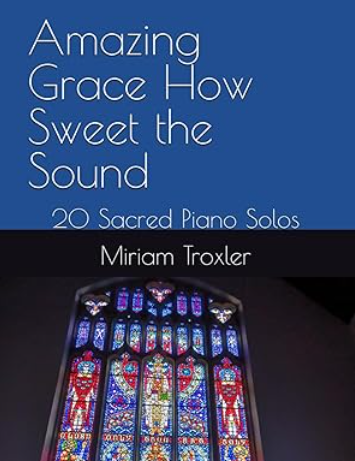
The third book for piano, Amazing Grace How Sweet the Sound: 20 Sacred Solos is the most advanced. Each title opens with a traditional statement of the melody then the second verse is a variation.
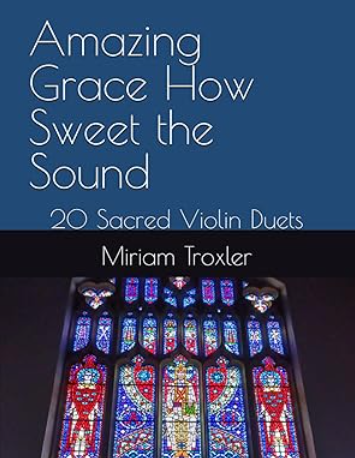
For string players there are three books. Amazing Grace How Sweet the Sound: 20 Sacred Violin Duets is for the treble clef players. It is laid out in score form. The second verse of the melody line is an octave higher than the first verse.
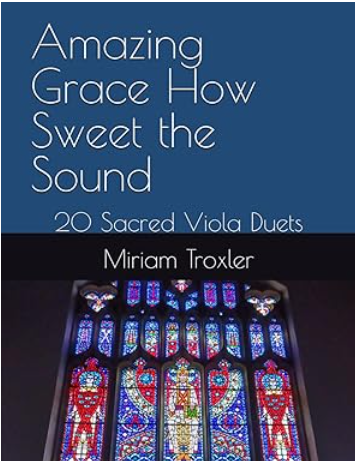
Amazing Grace How Sweet the Sound: 20 Sacred Viola Duets lets violists begin to work on treble clef reading. It is also in score form. The first verse of the melody is in alto clef, the second verse is in treble clef. The harmony part is different than the harmony part in the violin book

Amazing Grace How Sweet the Sound: 20 Sacred Cello Duets lets cellists begin to work on tenor clef. The first verse of the melody line is in bass clef. The second verse moves up an octave and into tenor clef. Also in score form, the harmony part is the same for both verses and different from the violin or viola books.
Therefore, the three string books can be used with two violins, viola and cello to play as a string quartet. Because the books are meant to be used with players of differing skill sets, if the melody player cannot play up the octave or read tenor or treble clef, a repeat of the first verse can be used instead. When playing with the Piano Duet and Piano Trio books, the piano books need to add a repeat or the string books need to stop after the first verse.



 Miriam Troxler